
AI Enablement Is Reshaping Roles
Presented by Wright Technical Services
Written by Denise D’Angelo
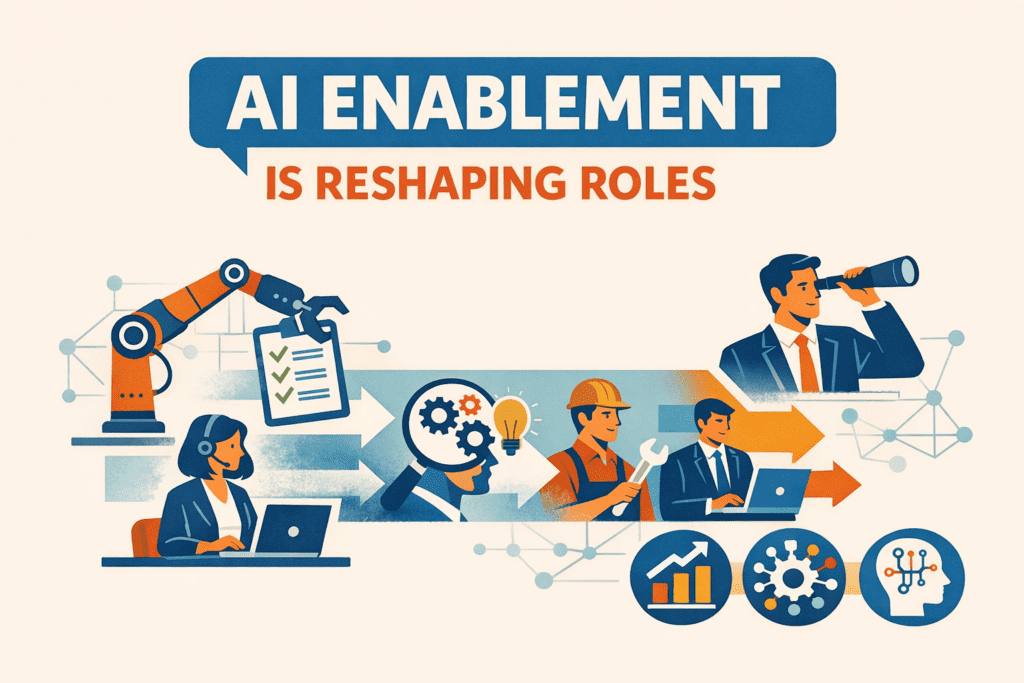
AI enablement is reshaping roles by expanding what individuals can handle across the day-to-day phases of work, creating the conditions for an AI-enabled, future-ready workforce.
For most of our careers, responsibilities were clearly bounded by titles and levels. Program managers coordinated. Analysts analyzed. Engineers built. Anything in between waited on handoffs.
AI connected to our knowledge bases and code repositories has changed the timing of work. Insight arrives earlier, and decisions no longer need to wait their turn. That shift is already changing how familiar roles engage the work.
Beyond One Prescribed Path
Access to AI-assisted analysis, writing, and basic coding means work no longer moves through a single prescribed path just because a role, title, or level is shared. This shift is happening alongside intense demand for AI-specific talent. While companies compete for a limited pool of AI engineers and data specialists, most organizations cannot hire their way into readiness. Expanding the reach of existing roles is becoming a practical response to talent scarcity, not a philosophical one.
In practice, this allows product leaders to shape problems earlier, project managers to contribute more technically when gaps appear, data engineers to explore connections and implications, and operations leaders to evaluate options without waiting for formal handoffs. The role stays the same. The path through the work changes.
What’s shifting is the expectation that work must follow one fixed sequence tied to a job description. Instead, effort flexes based on project phase, timing, and what needs attention to keep progress moving.
I’ve seen this repeatedly in transformation programs. Progress accelerated when team members were able to engage the work based on phase and need, their interests and abilities, rather than being constrained by title boundaries.
Discernment and Accountability
Work is becoming deliberately human–AI hybrid. This is a defining feature of an AI-enabled workforce. AI supports exploration and pattern detection. Humans provide judgment and accountability for what moves forward.
How far this expansion goes is not unlimited. AI trust is graduated, shaped by maturity, governance, and context. Discernment becomes the critical skill. Employees decide how deep to explore, manage AI output and sprawl, know when to trust results, when to validate them, and remain accountable for whether outcomes are realistic and accurate.
Because of this shift, decisions take shape earlier. By the time reviews occur, assumptions have been tested and recommendations are formed. Accountability rests not only on execution, but on the quality of judgment applied upstream.
This pattern is gaining traction. Microsoft’s 2025 Work Trend Index describes teams using AI to shape day-to-day work beyond fixed roles and processes, resulting in more varied and judgment-driven expressions of the same role.
Rethinking Career Structures
As roles evolve, we can expect performance measurement to evolve with them. Standard metrics struggle to capture judgment, interpretation, and follow-through when these appear earlier in the lifecycle.
I saw this firsthand while leading global HR for a SaaS managed services startup with an intentionally flat structure. As autonomy increased, the scope of responsibility diversified quickly. Individuals were taking on more tasks and stretching into new areas, building deeper expertise, and asking practical questions about growth: what this responsibility meant for their role, how it would be evaluated, and how it translated into advancement and compensation.
The structure enabled speed and autonomy, but career markers still mattered. Across cultures and geographies, titles, levels, and progression continue to signal credibility, pay, and opportunity. As responsibility expands, employees want clarity on how growth is recognized and rewarded.
This dynamic is accelerating with AI. As tools make it easier to analyze, test, decide, and execute across phases of work, responsibility expands faster and becomes more visible inside roles.
Organizations are responding as new tools and ways of operating take hold. Role language is evolving to reflect clearer ownership across analysis, decision-making, and execution. Titles such as AI Operations Lead, Agent Orchestration Manager, Model Risk Steward, and Responsible AI Product Owner are early signals of this shift. They point to a broader transition toward end-to-end accountability, with more change ahead as roles continue to reshape.
Organizing Around Blueprints
A growing trend is organizing work around problem-and outcome-focused blueprints. These blueprints clarify what needs to be solved, which decisions matter, and where accountability sits across business, engineering, or manufacturing contexts. They evolve as teams move through phases, without relying on titles to explain how work differs.
MIT Sloan Management Review (2024) notes a shift toward decision-centric, AI-supported outcome flows, capturing where humans retain accountability as analysis and execution become more tightly coupled through AI tools.
Generative assistants, embedded copilots, and AI-enabled planning and analysis allow teams to research, test options, draft, analyze, and iterate directly. Outcome-focused blueprints pull this together by making decisions, ownership, and AI involvement visible at each stage.
This is a rare moment where long-standing role structures loosen, opportunity expands, and AI enablement gives employees greater reach, faster feedback, and real influence over outcomes.
About Denise D’Angelo
Denise D’Angelo is a transformation executive specializing in AI workforce readiness, governance, and operating model evolution. Her experience spans Fortune 500 financial services, research institutions, and defense programs, where she has led enterprise transformation and AI-driven data strategy in regulated environments. A trusted executive facilitator and consensus builder, she brings disciplined clarity to workforce design, decision authority, and role strategy, aligning expanded AI capability with accountability and measurable performance, grounded in a Master’s degree from Johns Hopkins’ Whiting School of Engineering and graduate studies in Data Privacy Law at Seton Hall.
Stay on the cutting edge of industry news and insights.
Experience the Wright Technical Services difference.
More Posts in News & Insights
Supporting Performance in AI-Enabled Roles
Presented by Wright Technical ServicesWritten by Denise D'Angelo Leaders have taken deliber ... Continue Reading
Strengthening Hiring Decisions in AI-Enabled Roles
Presented by Wright Technical ServicesWritten by Denise D'Angelo Hiring has always involved ... Continue Reading
AI Readiness Is a Workforce Design Challenge
Presented by Wright Technical ServicesWritten by Denise D'Angelo Organizations are investin ... Continue Reading
What 2025 Hiring Taught Us: Essential Lessons for Future Recruitment Success
Key Takeaways Skills-based hiring became the new standard in staffing, with 85% of employe ... Continue Reading